
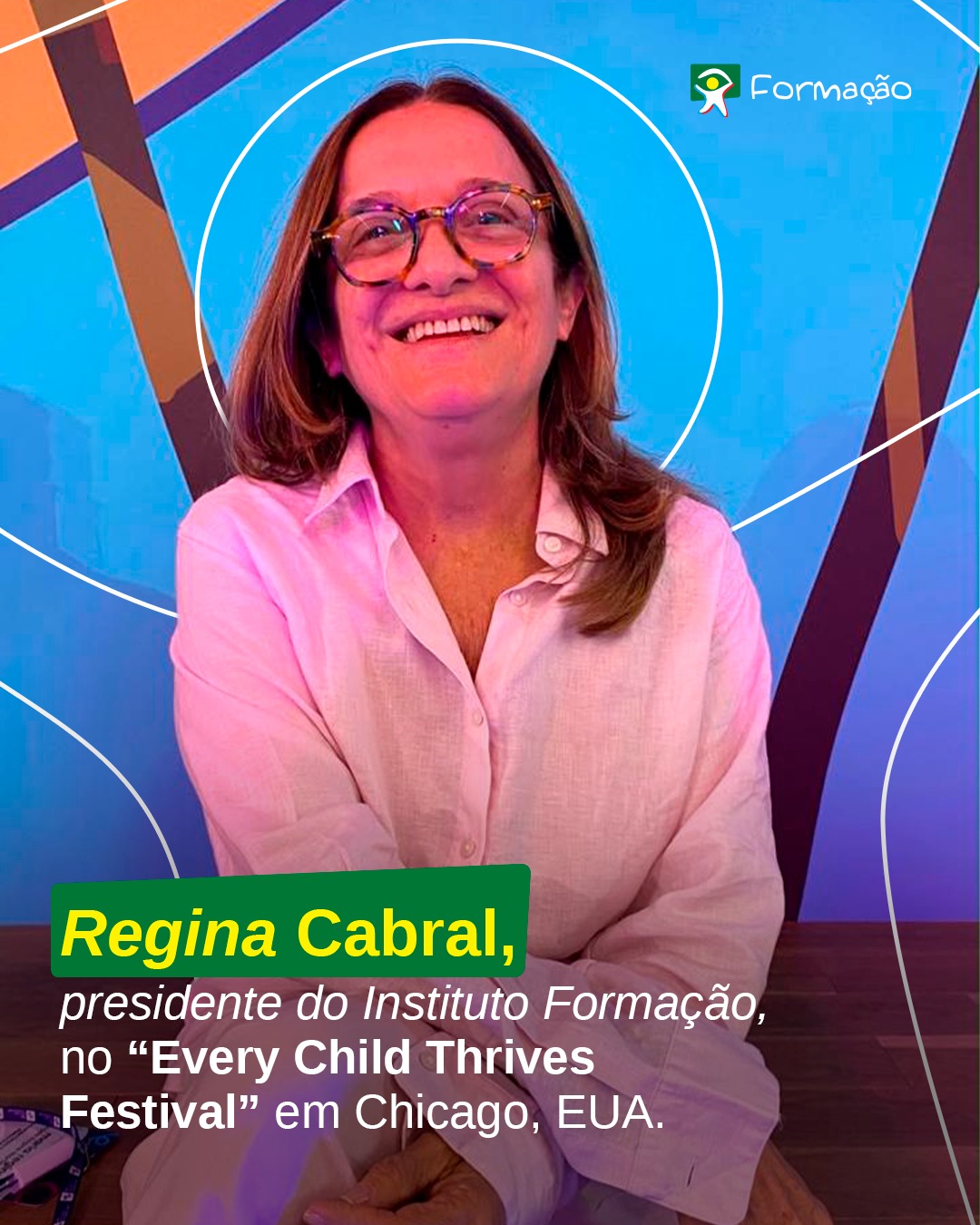
By Regina Cabral WKKF Global Fellow Network
There is a silent fever that consumes the days of the adult man. We walk the streets and sit at café tables with our eyes fixed on screens that endlessly show war statistics, continuous fragments of political struggles, and empty promises of an unattainable aesthetic. We feed, with the fuel of our own anxiety, the fetish of consumption and the ambition that devours a future shaped in the plastic of vices and selfish decisions. The public debate has become a desert of repeated ideas, where adults promise, mostly to win votes and defend private minority interests, to fix the collapsed walls of a building they themselves insist on imploding. We forget, however, that the architecture of the world is not changed at the top of corporate concrete towers, but rather at the height of a child’s eyes. Many of the abysses we stumble into today would simply disappear if childhood ceased to be the periphery of our concerns and became the center of gravity of our existence.
This change of focus, which pulses like an ancestral calling, echoed strongly under the lights of Chicago, during the opening ceremony of the Every Child Thrives Festival 2026 and continued in the consecutive speeches of the first full-agenda day at the Obama Museum. On the Kellogg Foundation stage, the voice of the presidency brought not just numbers or bureaucratic reports, but a manifesto for spiritual survival: there is an urgent need for care. If we transformed the dinner table, the relaxed chat of young people on the corner, and the strategic plans of large companies into altars of protection for children, we would be operating the greatest invisible revolution in history. Looking at the child is not an isolated act of charity; it is the only path to redraw the map of our own humanity, replacing the cry of war with the breath of creation.
When a society decides that its most precious asset is the laughter of a child, the geography of cities is transformed by charm and logic. Thinking about childhood is, consequently, projecting a city with open arms: with sidewalks where one can run, squares where the earth still holds the smell of rain, and an air that does not hurt the lungs when breathing. The commitment to the future of a little being requires a proud present and a redirection of focus, in which the forests remain standing, because no one destroys the tree knowing that the shade of the growing child depends on it, in which children are cared for in the present because everything that follows depends on this intelligent act. Under this luminous gaze, schools gain glass walls and valued teachers, health becomes a right as natural as oxygen, and the economy ceases to be an abstract monster of accumulation to become a generator of real development. Even old age gains a new spring: in a world that cultivates childhood, the elderly find longevity and embrace, for a community that knows how to nest the beginning of life naturally learns to honor its sunset.
The most profound miracle of this readjustment of focus occurs in the invisible fabric of the human soul. Childhood is the sacred soil where the roots of the adult are anchored. When we water this earth with affection, protection, and respect, the inevitable harvest is mature, psychologically stable men and women, immune to the cowardly need for violence and endowed with an empathy that embraces their fellow human beings. The adult who was fully loved and cared for does not need to wage war to feel strong, does not feed on the poison of structured lies, and does not surrender to the emptiness of unbridled consumption. Curing childhood is, ultimately, emptying the courts of the future and disarming armies before they even think of marching.
Therefore, the echo that reaches us from Chicago is not a lyrical utopia, but the most urgent pragmatism left to us. We no longer have time to spend our collective intelligence remedying the scars of evil when we have in our hands the power to prevent the wound from being opened. May the debate about the future step down from the arid platforms of human vanity and kneel before the cradle. Only when the world’s priority is to ensure that every child flourishes in their fullness will we discover that the world has, finally, become a civilized, clean place worthy of being called home.